…continued from Part 1
We turned off the main road and started up the first of many climbs that we were ahead of us for the day — our planned route wasn’t long in any sense at a paltry 55km of total riding, but there were significant altitude gains (around 900m), and more importantly, around half of it would be on singletrack and the rest would be gravel. (Here‘s the singletrack route profile.)
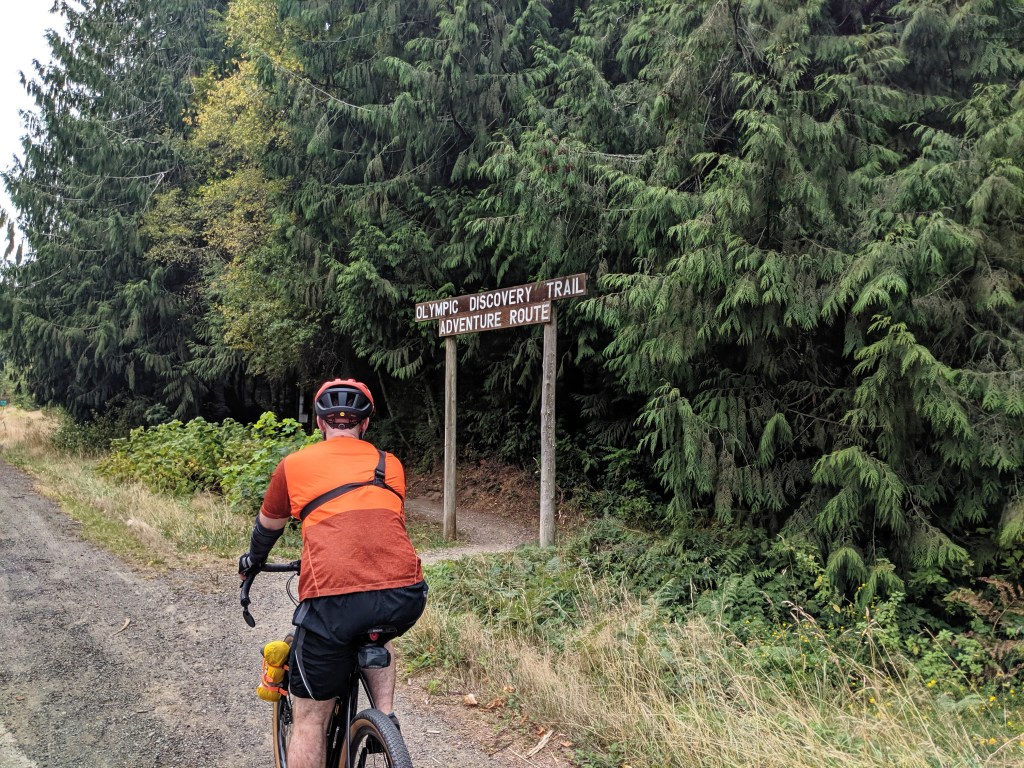
Mountain biking differs from road cycling in a number of ways: for road cycling, the challenges in bike handling come from the speed (the fastest I’ve been on a bike is 96 kph / 60 mph, but pros can hit up to 120 kph); in mountain biking, navigating features and going through loose surfaces is what causes trouble. Road cyclists endure pain for long climbs and are good at putting out an incredibly consistent effort; mountain bikers put out a ton of power in short bursts to clear obstacles and steep climbs. Road cyclists look like the human equivalent of a T-Rex (huge legs, no upper body muscles) tightly wrapped in lycra; mountain bikers wear loose shorts and actually have upper body muscles. I was a spandex-wearing, leg-shaving, aero-bike riding roadie through and through, and I would be totally out of my element on this singletrack, even with the 650B mountain bike tires I was using on my gravel bike. Fortunately, I had a seasoned mountain biker with me to lead the way.
The path through the forest was mostly packed gravel, which was something that I was certainly used to riding. And surprisingly, my bodged rear hub was holding up just fine, and so were the other parts of my bike — given my legendary mechanical competence, we had expected one thing or another to undergo spontaneous unplanned disassembly under the rigours of being ridden off-road while laden. I did need to re-index my rear derailleur once, but that was more due to 3T Exploro’s frame design than anything. (For anyone who’s considering getting the Exploro, the hang-loose derailleur with mechanical groupsets needs to be reindexed every time the rear wheel is taken out. I can see it being really good with Sram eTap though, especially for transporting the bike as you won’t need to take the rear derailleur out of the hanger.)
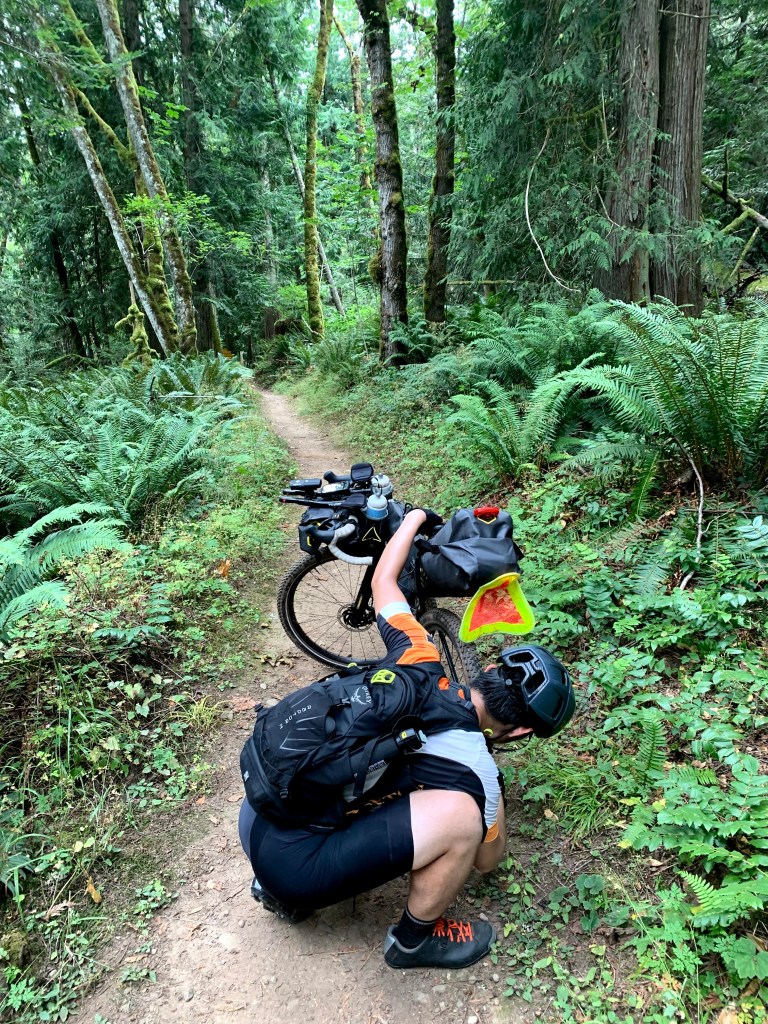
The derailleur issue fixed, we made quick work of the flowy, relatively flat singletrack for the next 10 kilometres: here’s some footage from Nathan’s GoPro. So far, I hadn’t had any trouble, but that was about to change.
When you’re falling in a forest, and there’s a bush of thorns
There’s an old Korean adage asserting that “Just starting out is half the deed”; on the other hand, the corresponding Japanese quote is “Only when you’re 90% through, are you at the halfway mark”. These two quotes to me epitomise just how different Korean and Japanese cultures are — Koreans like to charge headfirst into a problem and deal with issues as they arise, while the Japanese embody conscientiousness and meticulousness. (I’ll add why this difference exists to the list of future topics: the short version is that Korea has no natural resources except people and the Japanese have a long tradition of artisans serving people with swords.)
Their differences aside, the common truth highlighted by both of these quotes is the danger inherent in a status change: 20 percent of all car accidents happen in parking lots; 13 percent of all fatal aviation accidents happen during takeoff, and an additional 48 percent during landing; many people fall in love the first week of college just to have their hearts broken. Cruising in the status quo is easy, familiar, and safe; it’s what we do for most of our lives. Yet, the moments that truly define us are the brief, challenging moments of big transitions that punctuate the monotonicity of the quotidian schedules that we’ve honed to a perfection. Even with small transitions, we often fall when we have to stop and change what we’re doing. For me on this day, that fall was more than just a metaphor, and all it took to precipitate it was something so trivial that you wouldn’t even consider it a transition.
After navigating the start of a nasty climb, Nathan and I came across a road crossing that had a roadblock to prevent cars from accessing the trail, so we stopped, drank some water, and decided to go around on a narrow bypass. Nathan went around without incident, but when my turn came, I promptly and expertly clipped in, and then immediately and gracefully pedalled my bike straight into a metre-high ditch. As my rear wheel went over my head, I instinctively tucked my head into my chest so as to protect my vertebrae, and found myself stuck amidst a bush of thorns after two barrel rolls, still half-attached to my bike. (Now’s probably a good time to mention that my bike weighed 35 kg / 80 lbs — that’s an extra 350 kJ for the day fighting gravity, which is roughly equivalent to the energy contained in 30 AA batteries.)
Status check: I felt pain, so I was awake and conscious. I could move every part of body, and the pain wasn’t too bad, so likely, nothing was broken. (I have yet to break a bone in my body despite a few close encounters with death, so I have no idea what that pain feels like; I hope I don’t have to find out.) I was lucky to have fallen into a bed of grass; they had broken my fall so much that in terms of the impact alone, I may well as have fallen on a gym mattress. On the other hand, the same bed of thorns had left rashes all over my arms and legs, not to mention spines stuck in every part of my body. After checking that my bike was still in one piece, I carried my bike up, falling once in the process due to the weight.
(As you can see in the video, Nathan, ever a helpful friend, had wise words of advice for me: “Don’t fall.” Oh, and he was more worried about his bear spray in my backpack than whether I was okay, though I suppose that’s reasonable given how much capsaicin was in that can.)
All-in-all, the damage wasn’t severe — I took a couple minutes to remove the thorns from my arms, legs, hands, and feet, though I would still need to stop occasionally throughout the rest of the day to remove new thorns that I found as I shifted my position on the bike. Nothing had come loose on the bike either, which was respectable. As I debated whether it was worth going through my medkit to find anti-itch cream and / or sterilisation for my new badges of honour, I looked back on what had just happened.
I don’t fall often (other than in love, usually with disastrous consequences), and when it looks like I’ve fallen, it’s usually because I’ve jumped for whatever reason. In fact, I never once fell when I was a toddler learning to walk — apparently I started walking while holding on to an object much earlier than other babies, but then never tried to walk on my own until I was ready to do it perfectly, much later than other babies. (My parents thought I was never going to let go.) The last time I’d fallen on a bike had been in September of 2014, when I was first learning to ride with clipless pedals as I was getting into cycling. I hadn’t fallen going through the sandy singletrack in Pine Barrens; I hadn’t fallen descending quickly through hairpins on Tenerife; even in Morocco, through what could be very charitably and imaginatively called “roads”, I hadn’t fallen. But here, I’d had an honest-to-god fall. And I’d literally driven straight into it, eyes wide open, right after I had deftly navigated the trail through the forest. (Nathan had just commented that I looked like I knew what I was doing, notwithstanding the incongruence between the trail and the sight of a lycra-clad, clipless-riding roadie.)
The only explanation that I could come up with was that I’d seen a car road and had automatically gotten myself into a road mindset. Navigating around roadblocks was something that was second nature to me (Princeton folks can think of the Delaware & Raritan canal path), and I’d forgotten that I was supposed to be doing trail riding. And this small transition — this minute change in my mental state — had been enough to throw me off. We continued on our path, lesson learned, and me, a bit worse for the wear.
(Side note for non-cycling friends: Clipless pedals are, despite the name, pedals that you can clip into to attach your feet to the bike — think ski boot bindings. The name is a holdover from the earlier days when people would use toe clips. The benefit is that you are more stable on the bike and can put out more maximum power since you can pull the pedal upwards.)
(Side note for the linguistically inclined: Is there a word that describes the class of nouns that actually mean the opposite of what the word ostensibly means? What about a word that describes the class of nouns the meanings of which are incoherent with how they subjectively sound (e.g. ‘pulchritude’)? Let me know if you know the answer!)
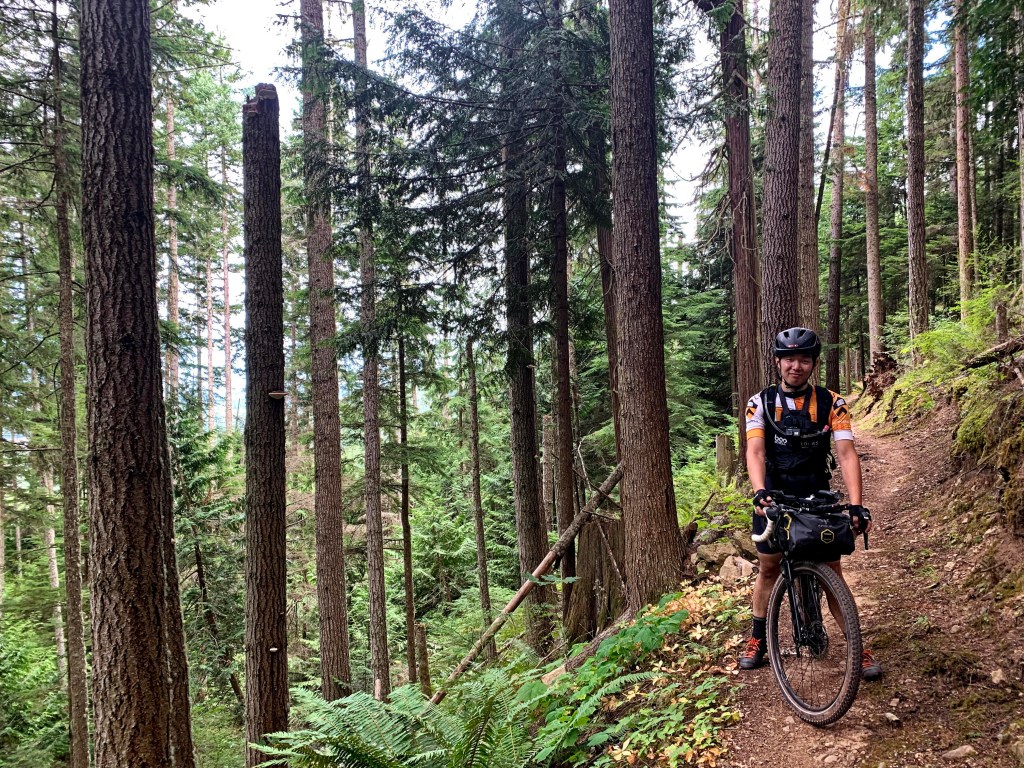
A fall here would have been so much worse.
As we went deeper into the trail, I became very grateful that I fell where I did and not anywhere else. The trail was cut into the side of the mountain through the ferns and the evergreens; just to our right was a ten-plus metre drop into the ravine. On the faster downhill sections, I wondered what Nathan — who was far ahead of me — would even do if he saw a rider coming the other way. In some sections, two riders could hardly pass each other even if one was standing, and there was nowhere you could go to avoid someone showing up around a blind corner. Fortunately we didn’t have to find out.
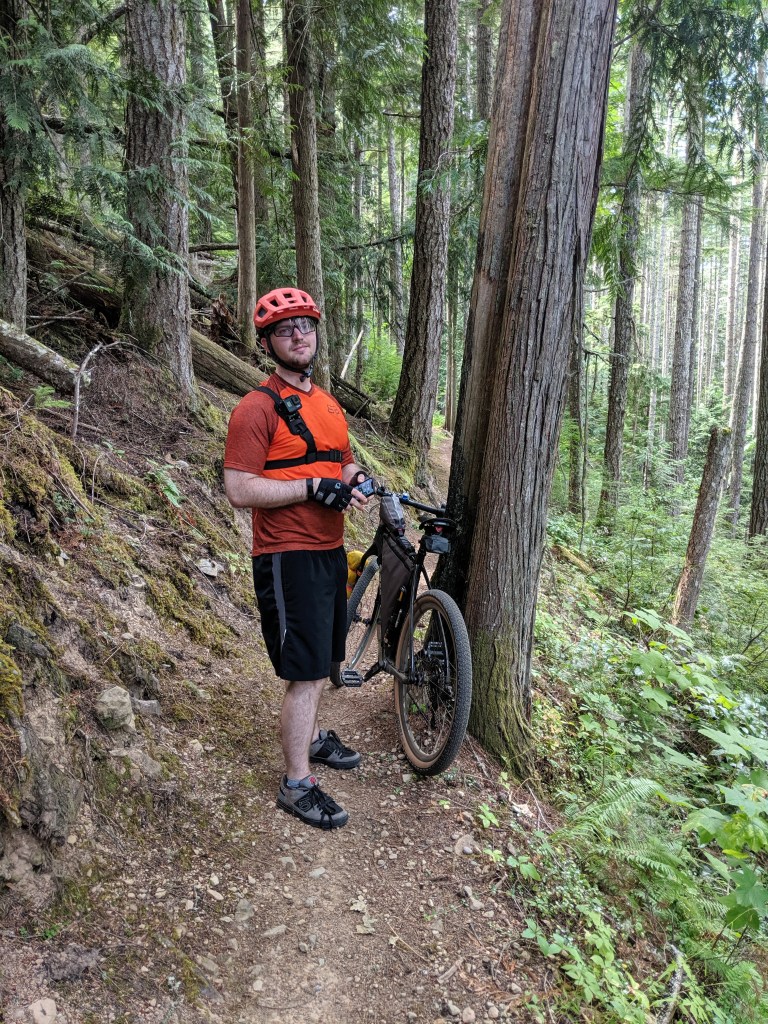
The trail turned skyward. We started our arduous climb through the switchbacks, and I needed to unclip and put my foot down every now and then because of the toe overlap from the small frame I was riding. Every few metres, there would be another hairpin switchback, and every few metres, I would need to unclip and push my bike around the corner only to struggle to start up. My bike weighed half as much as I did, and as obscenely easy as my easiest gear (33-32 from a compact Sram Red eTap AXS chainring married to an 11-speed 11-32 cassette) was by traditional roadie standards, starting my bike up 12% gradients on gravel was no easy feat. I somehow still managed to make it to the top of the climb with minimal hike-a-biking.
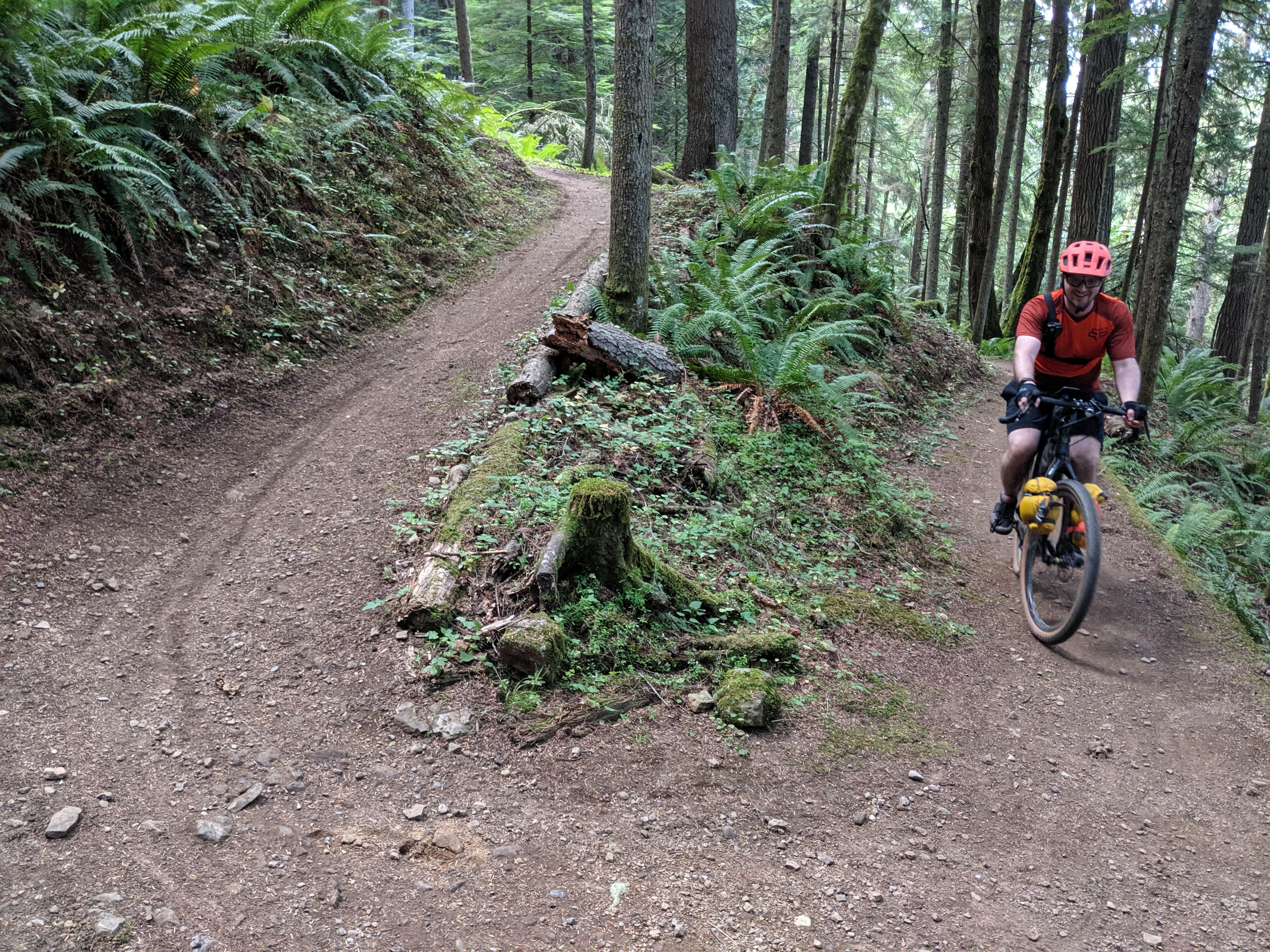
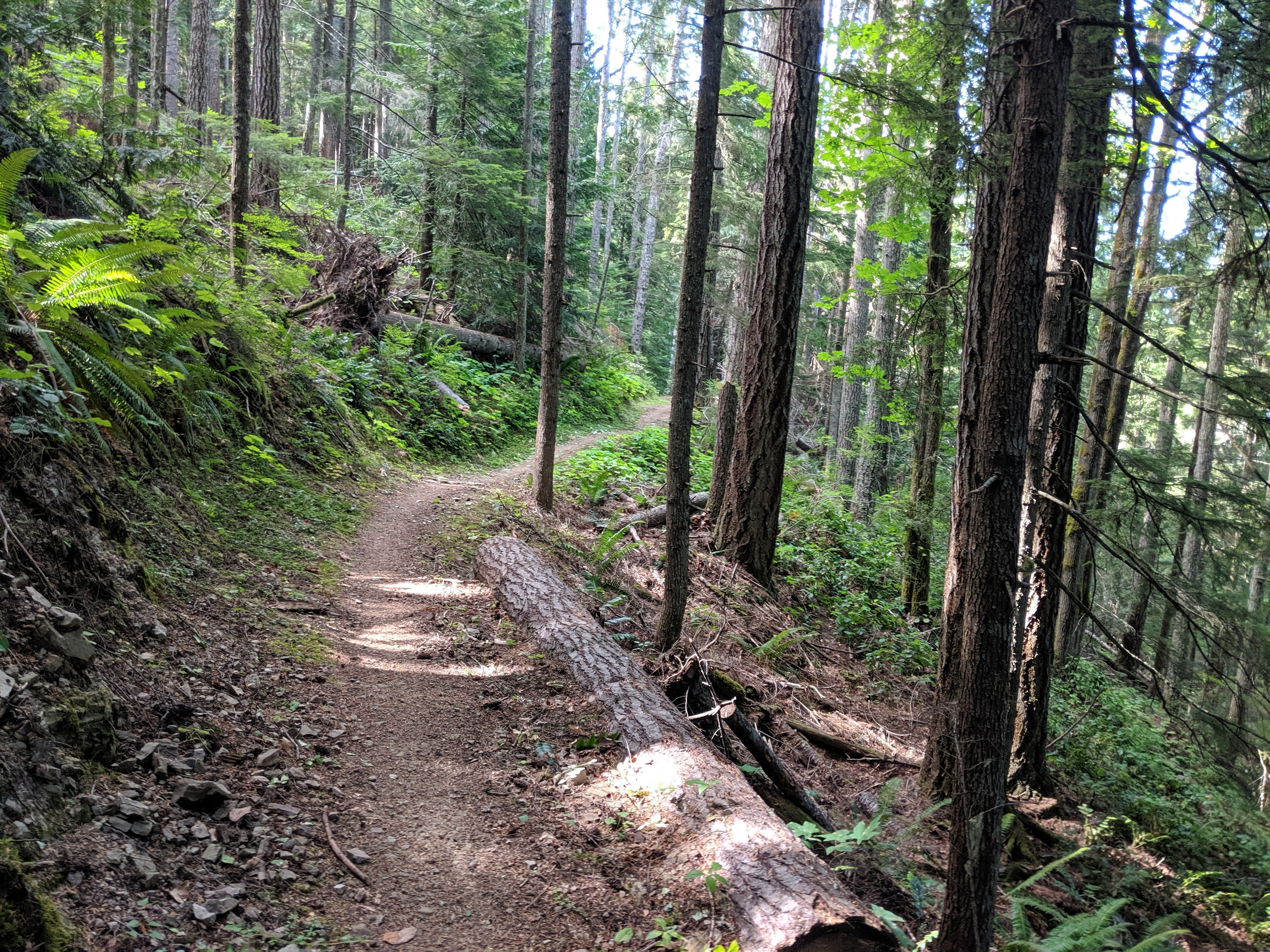
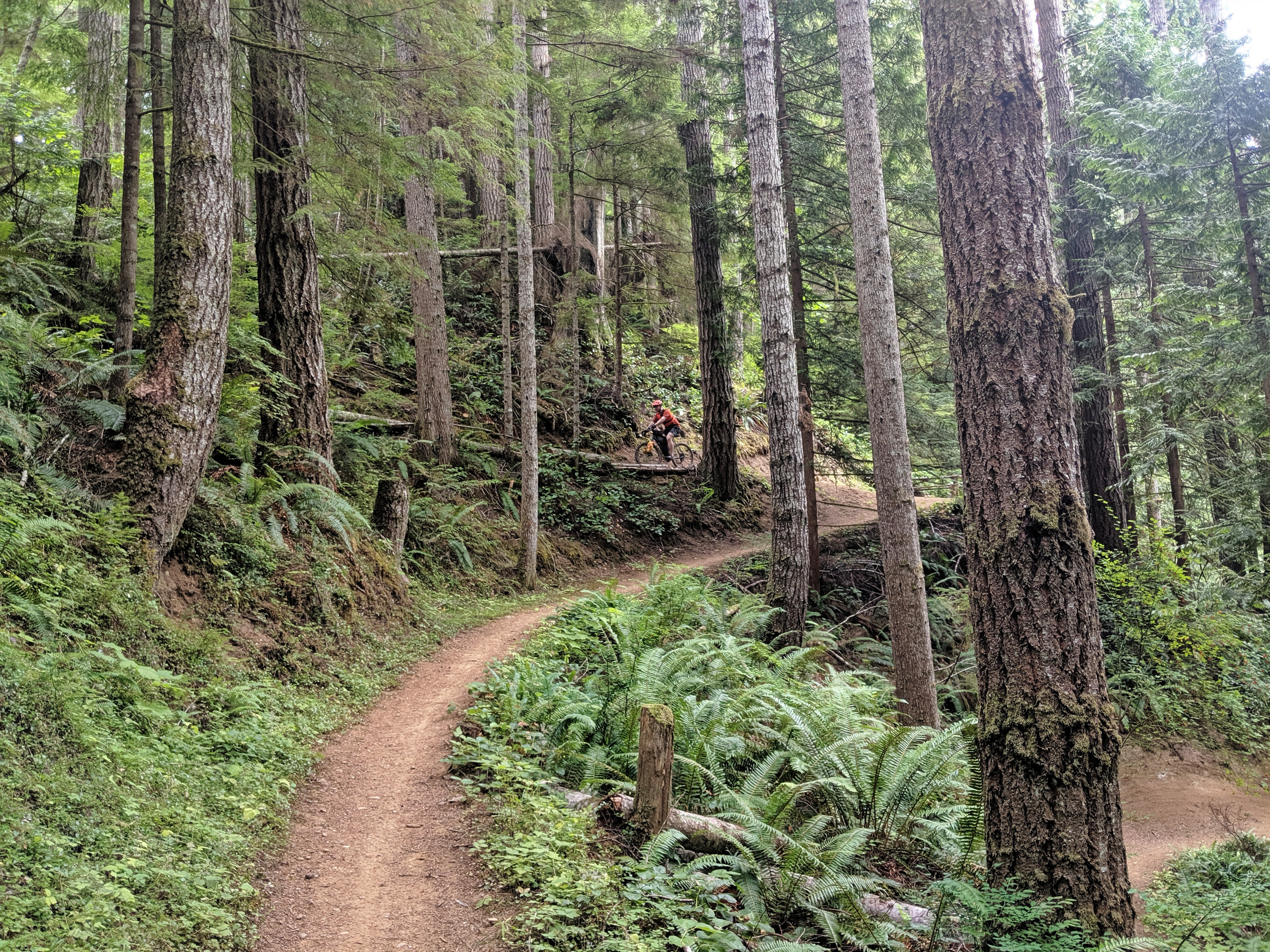
While I struggled, Nathan had less trouble navigating the switchbacks. He’d done this trail before, and he was also riding with much less weight on platform pedals — he still did need to put his foot down occasionally.
Once we reached the top of the climb, the ridge opened up into a spectacular view to the north. What had started as a dreary, cloudy day was now a sunny day, and the endless sky was beaming at us from behind the patchwork forest, dressed in the shade of light cerulean that I so cherished. I don’t think one can really appreciate just how beautiful the skies over America are unless, like me, you grew up in a smog-filled East Asian megalopolis — oh, how I love being in this country, and how I’ll miss it! And far off, we could see Canada, where I’d spent my high school years and learned English as a second language.
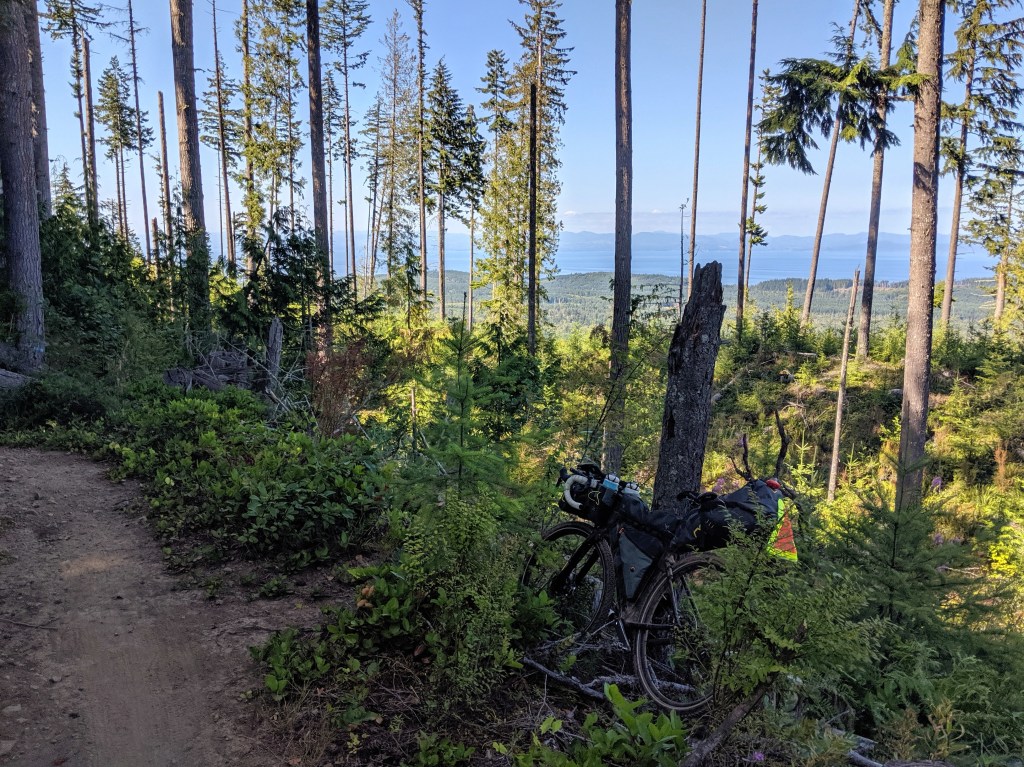
You can see Canada!
The ride along the ridge was a flowy, gentle downhill between the flowers — it was nice to see the sun for a change. Nathan was a fair bit in front of me because I took a break to snap some photos, and when I saw him again around a corner, he was… well, I’ll let you come up with your own words from the picture below.
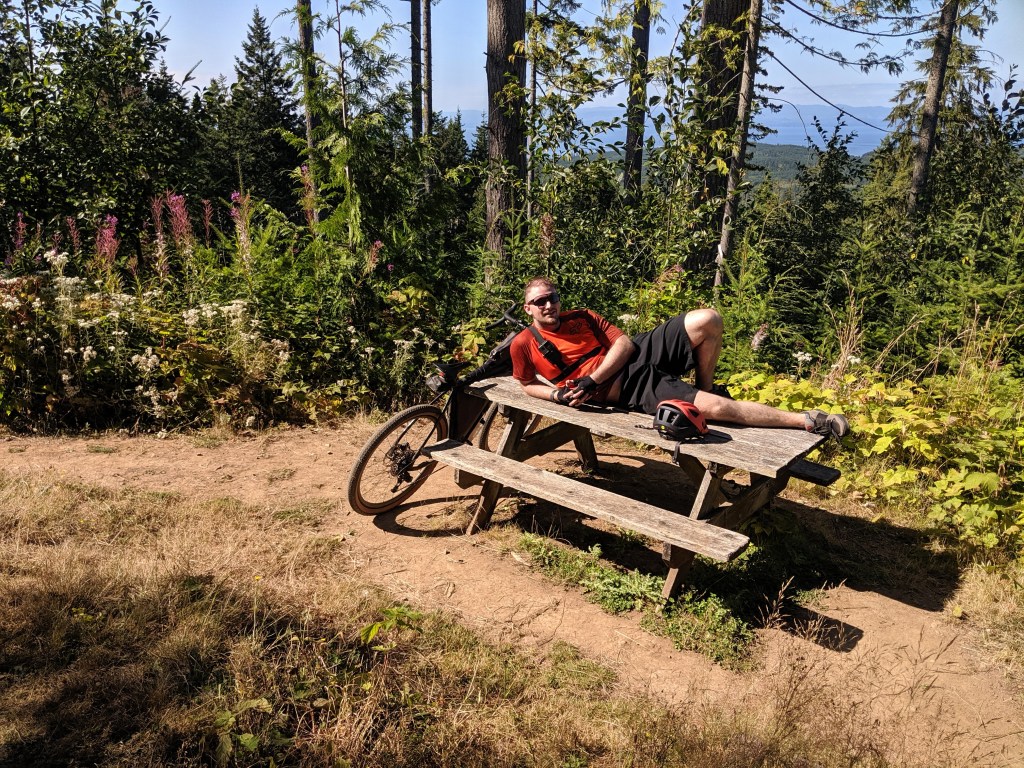
Yikes.
From here, it was mostly just an hour of descending on more singletrack until we joined the gravel road. Normally I adored descents, but the switchbacks were a bit sketchy, especially given how heavy my bike was — the bike seemed to have a mind of its own. (As various descendants of Hegel adhering to his dialecticism might’ve put it: “Quantity has a quality all its own”. This rang true for my bike’s handling.) So naturally, I maintained a persistent death grip on my poor brakes. My fingers started cramping, and by the end of the day I physically couldn’t open my fingers without prying them open using the other hand.
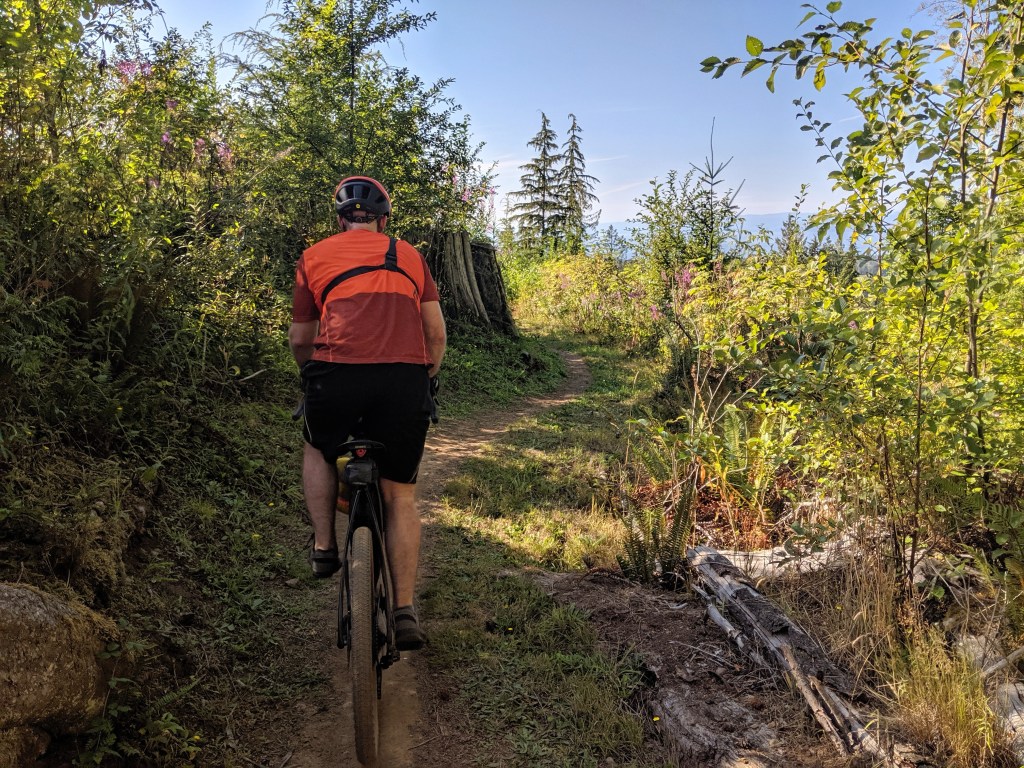
Randomly meeting people from home
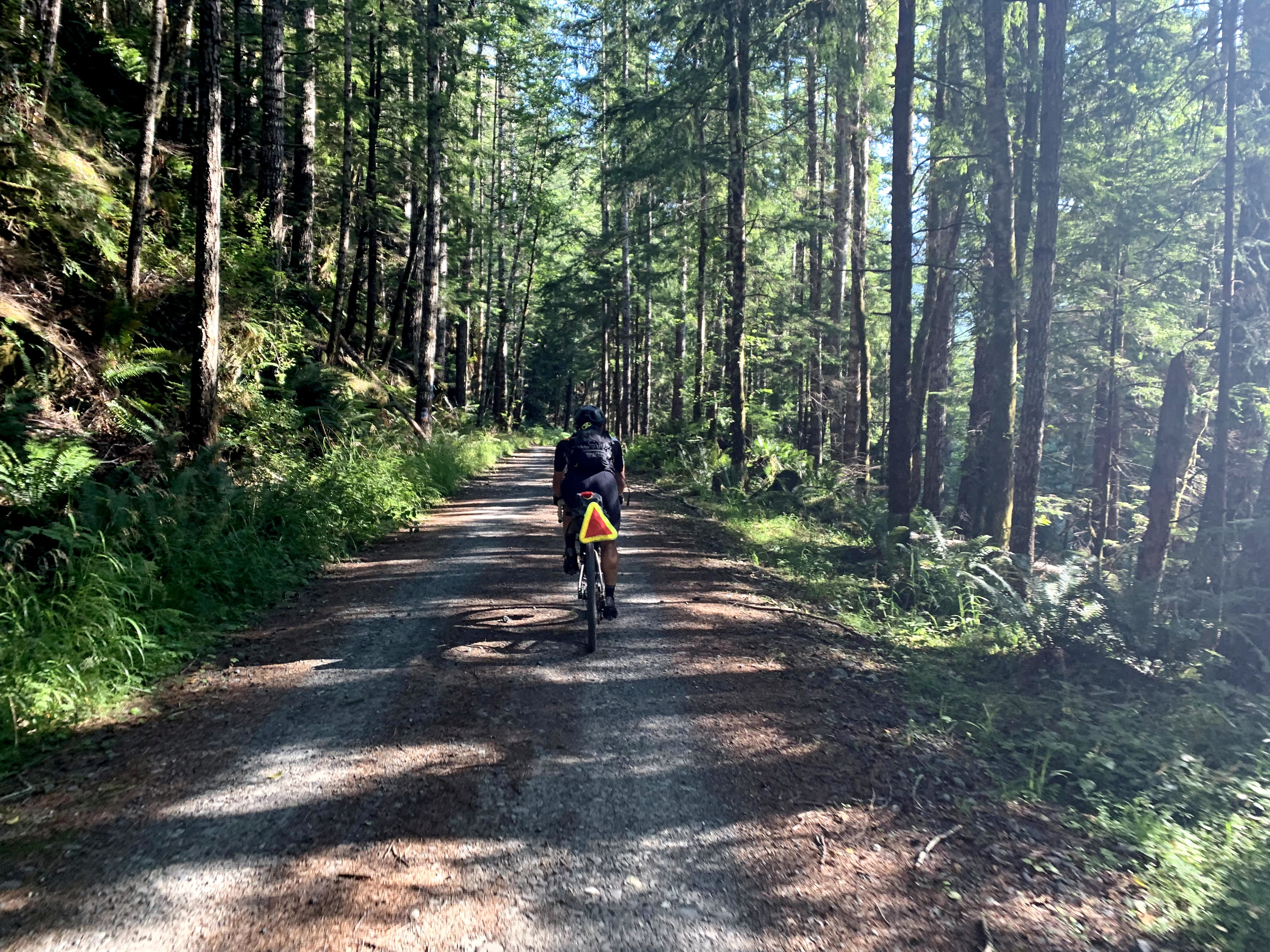
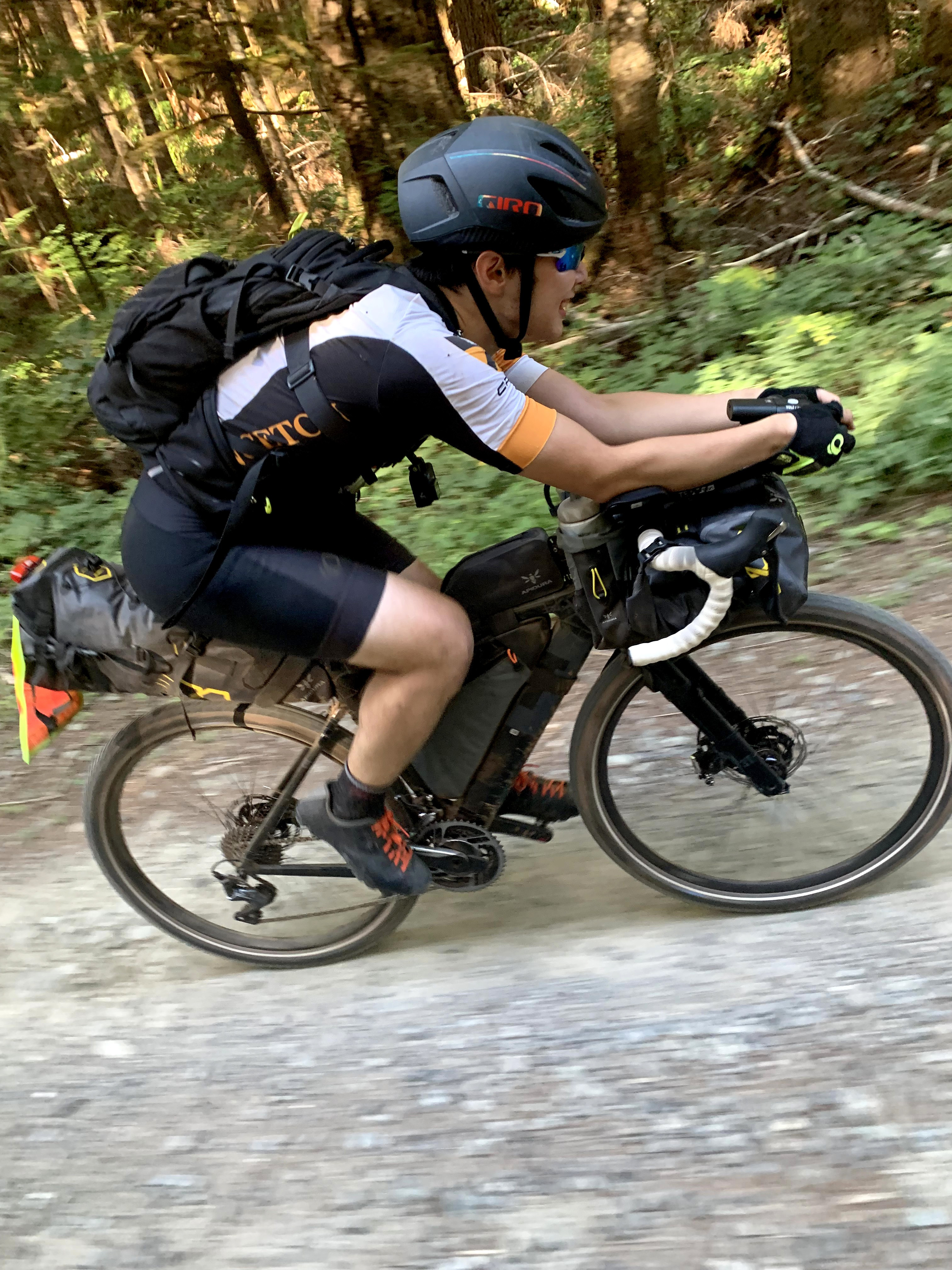
We finally reached the gravel road and I was back in my comfort zone, happy to use my aerobars. When we came onto the pavement from the gravel, we took a wrong turn onto what looked like a path and ended up on the shore of Lake Crescent — and ended up bumping into the couple from the previous day who were camping in the campsite next to us. They’d decided to stealth camp there, and had done the same trail as us on hybrid bikes. Having wished them a pleasant evening, we set out towards our campsite, which was still 15 km or so away.
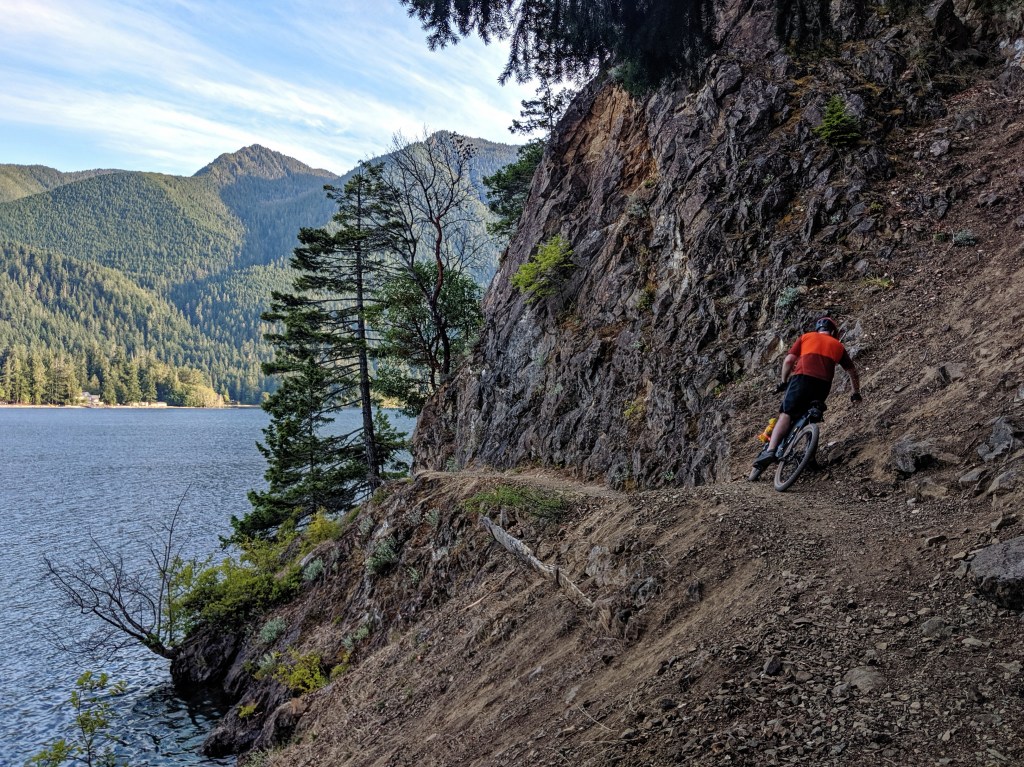
This is what a ‘trail’ looks like.
The pavement turned back into gravel, and gravel back into singletrack as we headed west along the shore. Lake Crescent was simply stunning in the late afternoon sun — being a glacial lake, the fine glacial silt particles suspended in the water scattered light (I’m not sure if the silt falls under Rayleigh scattering regime) in ways that pure water doesn’t, and imbued the lake with an ethereal azure hue that has to be seen to be believed.
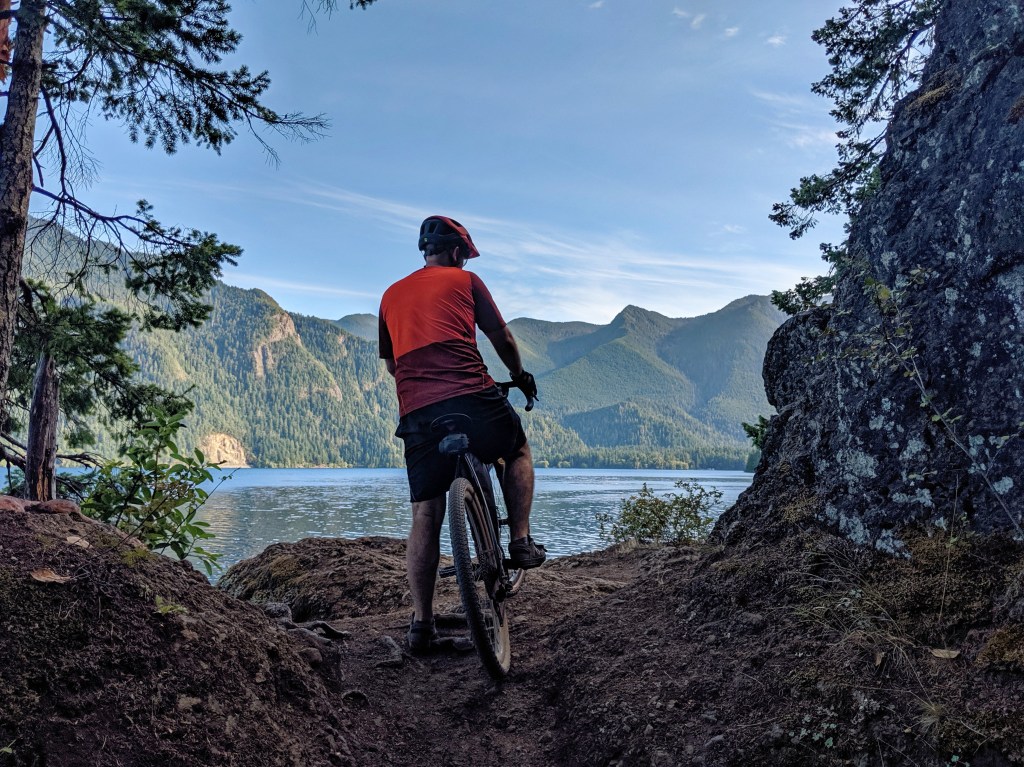
This has to be one of my favourite photos that I’ve taken in a while….
We briefly filled up on water (it was Nathan’s first time using a filter straw or an iodine tablet), and continued on jagged rocks — we were on a rail trail, and it seemed that no one had bothered to replace the track ballast with something more pleasant to ride on. Somewhere during the rough ride, I ended up dropping my phone and I had to go back to find it, much to Nathan’s chagrin. When I came back, though, Nathan had struck up a conversation with another cycle tourist named Quinn.
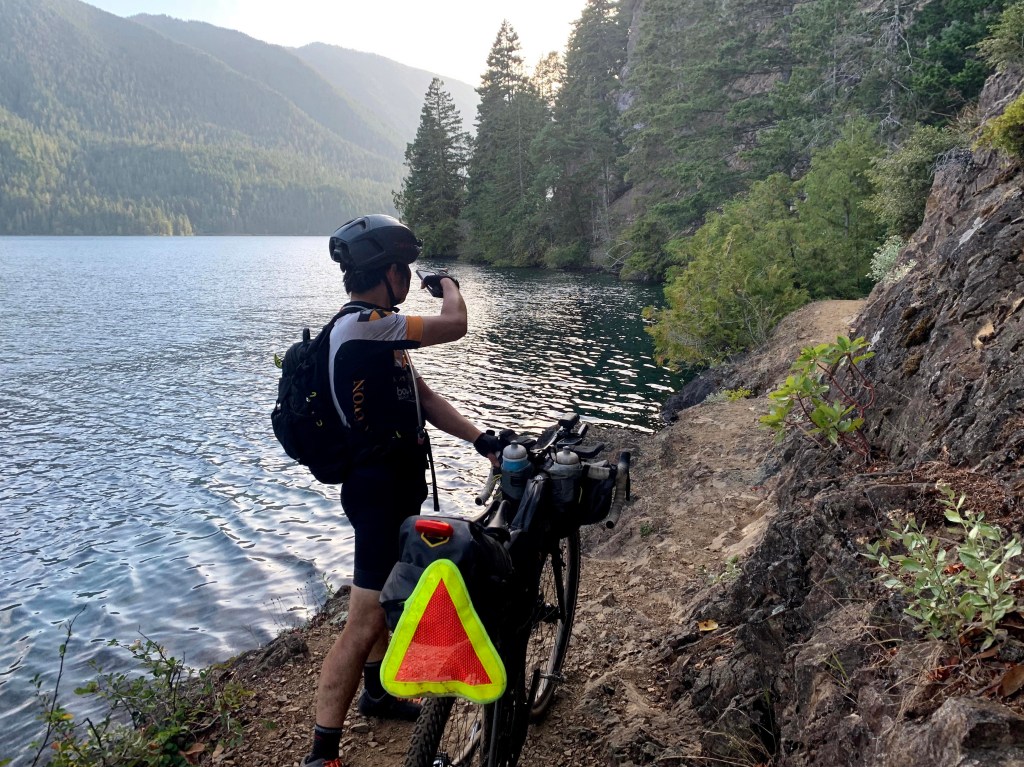
One of the great magics of bikepacking (and cycle touring) is how accessible people are when you’re on a loaded bicycle. You’re very clearly not a threat; you’re signalling openness; you’re vulnerable; you’re likely foreign; you’re doing something interesting. All of these things bring out the best qualities in people (more on that in the next part), and people want to talk to you. They want to know what you’re doing, where you’re from, where you’re going, if you need help, and so on. Add the usual solidarity between cyclists, and it’s not a surprise that cycle tourists / bikepackers get along so well with each other. We were headed to the same campsite, so Nathan and I decided to follow Quinn and his cousin Frankie — they looked like they knew what they were doing. And as it turned out, they certainly did. (Immutable truth: anybody who has a jar of peanut butter in a water bottle cage knows what they’re doing.) They had biked to the northwesternly extreme of the contiguous United States from none other than northern New Jersey over four months, and this was the final part of their trip. And furthermore, they were the very same cycle tourists that we’d seen lugging up Hurricane Ridge that morning.
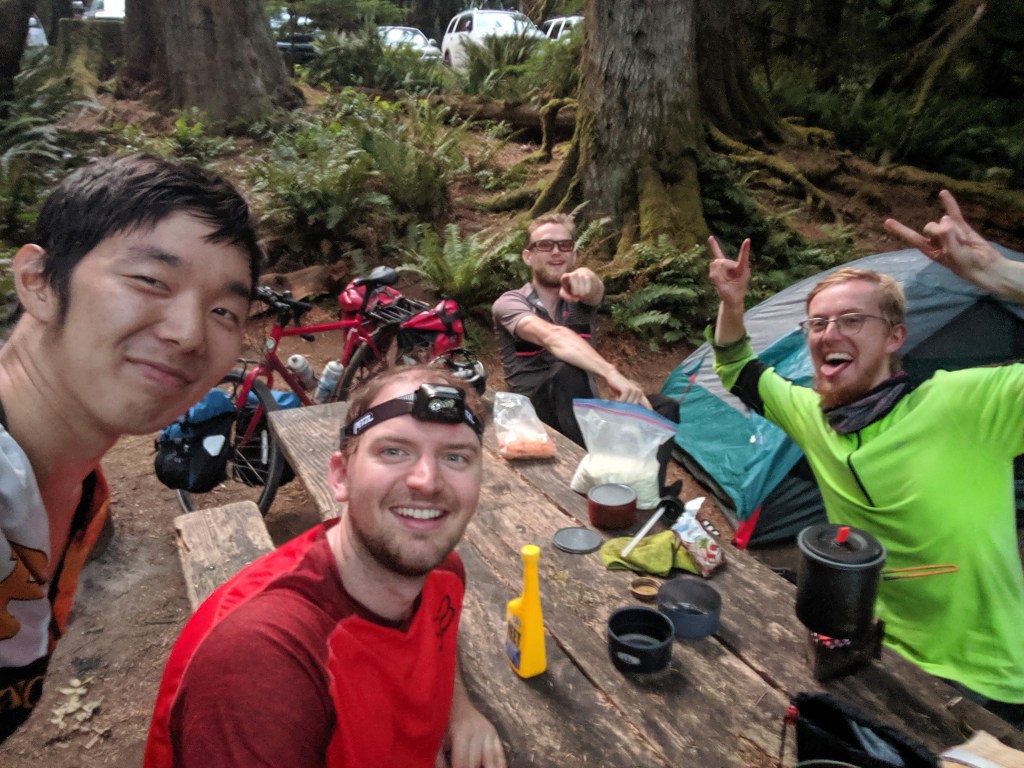
I take blurry selfies — sorry guys.
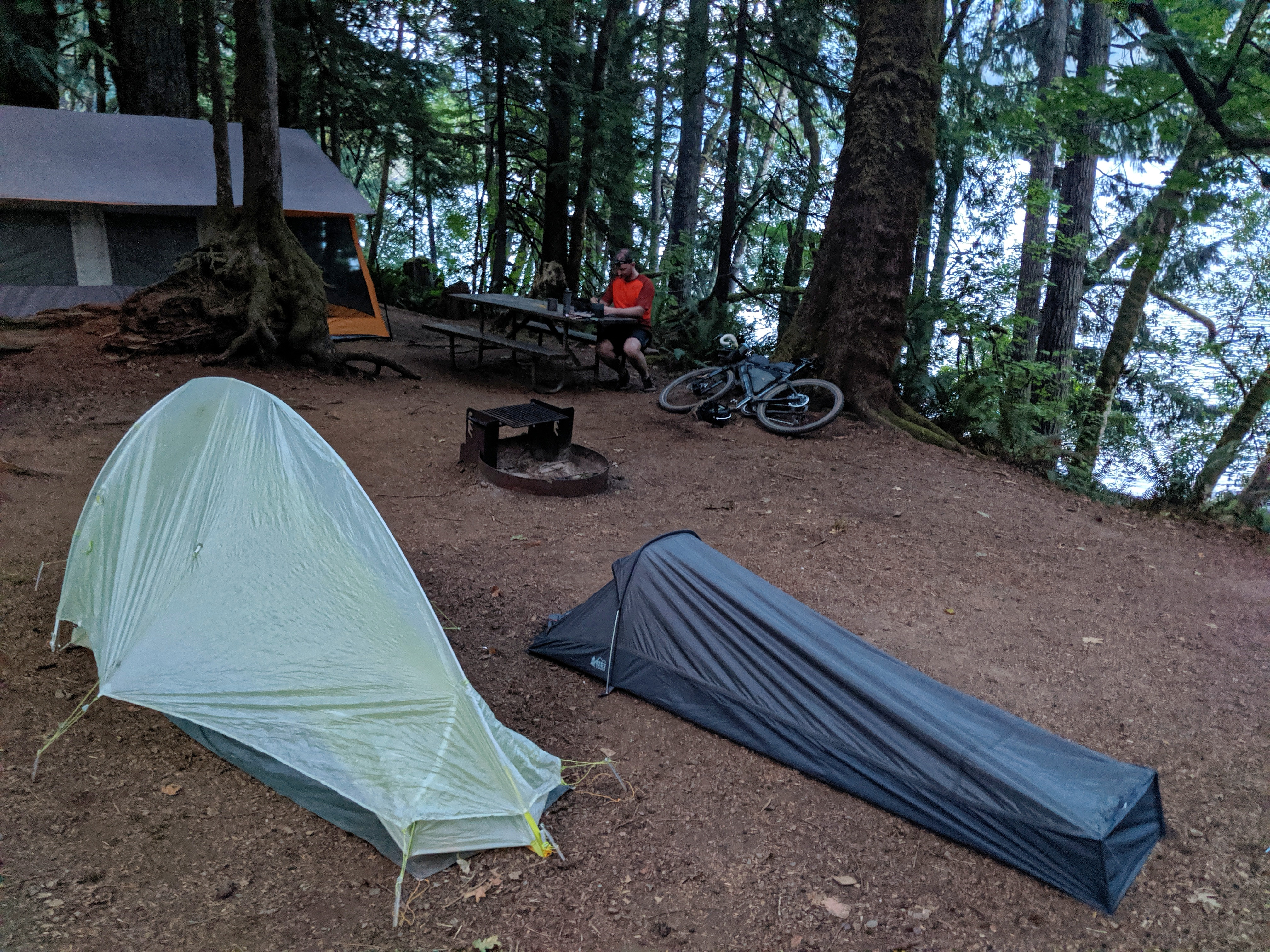
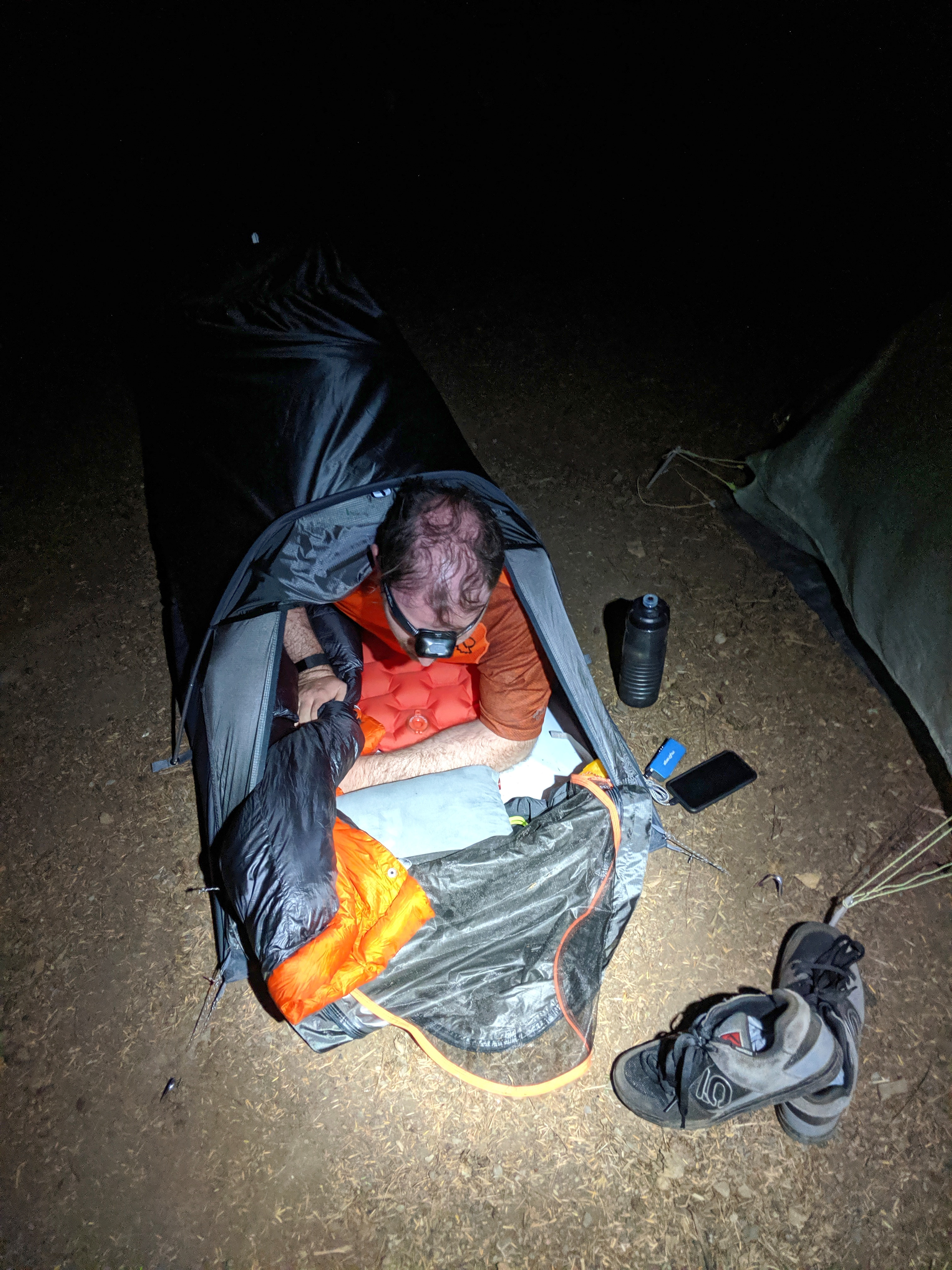
This was an amazing experience that made me realise once again how small the world can be — I occasionally rode through one of their hometowns on my training rides. We set up on neighbouring campsites, I asked them for advice on long distance touring as they cooked dinner, and we bonded over our mutual pet peeve of cars trying to pass cyclists on downhills already going faster than the speed limit. Nathan and I staked out our little corner of the world, cooked couscous for dinner, and went to sleep.
continued and finished in (what I hope to make a shorter) Part 3…
P.S. A friend reminded me that one of my goals starting this blog was to highlight unusual connections, and that I haven’t gotten around to doing that yet. Just so that he doesn’t feel completely cheated reading my travel journal, I’d like to point out that the English word “colour” is related to the word “caste” via Proto-Indo-European, while the Chinese character “色” for colour comes from how a person’s body (and specifically their face) looks when they’re kneeling; the usage of the word for general colour was a later addition. (Interestingly, the Hungarian word “arcszín” also means both “complexion” and “colour”.) It’s notable that in both instances, colour was so central to identification of other people across cultures (c.f. clothing customs of Shilla, which was an ancient Korean kingdom that stood for a thousand years — their elaborate caste system was very much colour-coded), but perhaps it’s not surprising given the massive utility of colour in distinguishing between different things, particularly between things that are edible and things that are not.
 Beyond Categorization
“Janus words” mean both their meaning and the opposite of that meaning.
Clip is actually a good example of a Janus word, even outside the context of clipless pedals, since clip can mean either to separate/cut or to join/fasten.
LikeLiked by 2 people